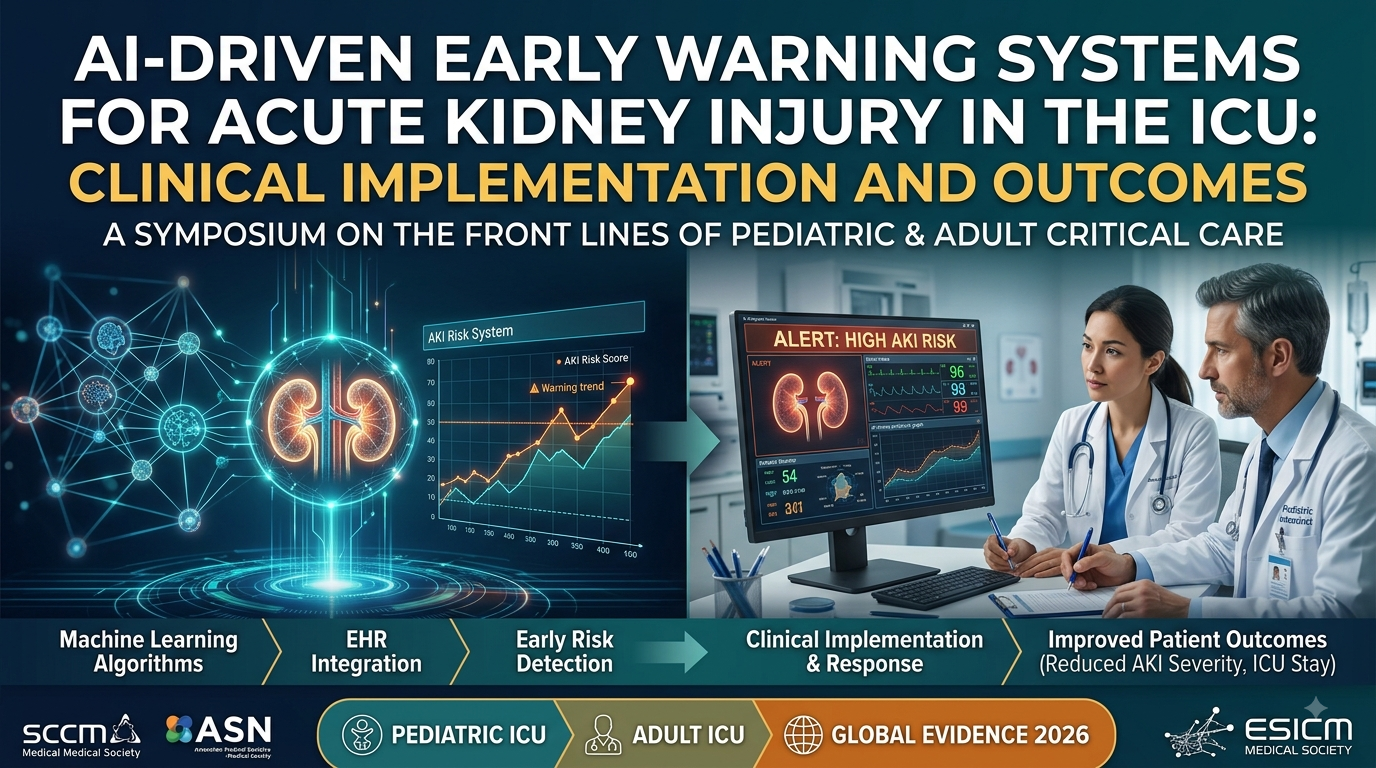
- Diagnostic Impact: AI-driven EWS overcome the 24-48 hour diagnostic lag of traditional creatinine, predicting AKI up to 48 hours pre-threshold by leveraging multidimensional EHR data.
- Clinical Mechanism: AI EWS utilize continuous multimodal EHR data fusion and novel tubular injury biomarkers (TIMP-2, IGFBP7) to differentiate AKI subphenotypes for tailored intervention.
- Actionable Protocol: Tiered notification systems prevent alert fatigue, enabling timely "KDIGO Care Bundle" implementation, significantly reducing severe AKI incidence, RRT duration, and ICU length of stay.
AI-Driven Early Warning Systems for Acute Kidney Injury in the ICU: Clinical Implementation and Outcomes
Acute Kidney Injury (AKI) remains one of the most prevalent and severe complications encountered in intensive care units globally, affecting up to 50% of critically ill adults. Traditional diagnostic parameters—predominantly serum creatinine elevation and decreased hourly urine output—suffer from intrinsic kinetic lag. Serum creatinine typically rises 24 to 48 hours after subclinical parenchymal damage has already occurred, severely curtailing opportunities for nephroprotective interventions. The integration of continuous machine learning algorithms and AI-driven early warning systems (EWS) represents a significant advance toward predicting oliguric and subclinical AKI prior to irreversible tubular necrosis.
The Biomarker Kinetic Deficit in Conventional Diagnostics
Standard clinical staging systems (KDIGO, RIFLE) rely heavily on functional filtration markers rather than direct structural injury metrics. In early hemodynamic instability or septic insult, compensatory renal vasodilation maintains the glomerular filtration rate (GFR) despite active nephron injury. Consequently, reliance on serum creatinine delays critical interventions such as nephrotoxic agent cessation, targeted hemodynamic optimization, and early volume management.
Machine learning architectures overcome this limitation by continuously ingesting multidimensional electronic health record (EHR) stream data—including continuous vital signs, arterial line wave dynamics, blood gas analysis, serum electrolyte trajectories, and cumulative fluid balances—identifying subtle physiological signatures predictive of impending renal failure up to 48 hours before clinical thresholds are met.
Algorithmic Architecture and Predictive Performance
Modern clinical decision support models employ deep recurrent neural networks (RNNs) and gradient-boosted decision trees trained on extensive multi-center ICU datasets. Key diagnostic components include:
- Continuous Multimodal Feature Fusion: Real-time integration of physiological streams, lab values, and pharmacological orders to generate dynamic AKI risk probabilities every 15 to 30 minutes.
- Biomarker Synergy Integration: Coupling algorithmic predictions with point-of-care tubular injury biomarkers, such as tissue inhibitor of metalloproteinases-2 (TIMP-2) and insulin-like growth factor-binding protein 7 (IGFBP7).
- Subphenotype Discrimination: Differentiating functional prerenal azotemia from intrinsic acute tubular necrosis (ATN), tailoring fluid management strategies accordingly.
Mitigating Alert Fatigue and Workflow Integration
A primary barrier to widespread clinical adoption of AI decision support is alert fatigue—where excessive or non-specific notifications lead to clinician desensitization and alert suppression. To preserve clinical efficacy, second-generation AI systems employ contextual suppression filters and risk-stratified notification tiers:
- Tier 1 (Moderate Risk): Passive EHR dashboard indicators prompting non-invasive monitoring and medication reconciliation.
- Tier 2 (High Risk): Active clinician notification recommending a structured "KDIGO Care Bundle" (hemodynamic optimization, avoidance of nephrotoxins, functional fluid responsiveness testing, and strict urine output logging).
- Tier 3 (Impending Severe AKI): Automated multidisciplinary alert triggering nephrology consultation and protocolized renal replacement therapy (RRT) planning.
Clinical Outcomes and Future Directions
Prospective clinical trials evaluating AI-driven AKI early warning algorithms report significant reductions in stage 2/3 AKI incidence, decreased duration of renal replacement therapy, and shortened overall ICU length of stay. Future developments focus on closed-loop feedback integration and federated learning models to continuously refine predictive precision across diverse patient populations without compromising data privacy.
References
- Koyner JL, Carey KA, Edelson DP, Churpek MM. The Development of a Machine Learning Algorithm for the Early Detection of Acute Kidney Injury in Hospitalized Patients. Crit Care Med. 2018;46(7):1070-1077.
- Tomašev N, Glorot X, Rae JW, et al. A clinically applicable approach to continuous prediction of severity of acute kidney injury. Nature. 2019;572(7767):116-119.
- James MT, Basu RK, Neyra JA, et al. Artificial Intelligence and Machine Learning in Acute Kidney Injury: Current Status and Future Horizons. Kidney Int. 2024;105(4):712-724.
- KDIGO Clinical Practice Guideline for Acute Kidney Injury. Kidney Int Suppl. 2012;2(1):1-138.
Academic Collaboration & Consulting
Select a clinical research or writing service below to inspect deliverables and submit an immediate, direct inquiry to Dr. Rahul Parajuli.
Article Review & Literature Review
Rigorous scientific evaluation of medical literature and manuscript drafts. Providing structured peer-review quality assessments, methodology audits, and exhaustive literature mapping for prospective studies or clinical guidelines.
Key Deliverables & Methodologies:
- Critical Appraisal & Peer Review Reports
- Systematic Literature Search & Evidence Mapping
- PRISMA-compliant Literature Reviews
- Methodological Quality & Risk of Bias Assessment

Dr. Rahul Parajuli
Physician & ResearcherPhysician, Clinical Informatics Researcher & Health-AI Architect. Specializes in acute critical care telemetry, full-stack biomedical engineering, Schema entity graph architectures, and high-performance search systems.
Community Discussion
0 Contributions